Wednesday, October 22, 2008

Finally catching our breath a bit

Gotta dig those sky-high flyovers! This is where the Sam Houston Tollway meets the Rt. 59 Highway over in Sugar Land, Texas, a part of Greater Houston.


Things are finally winding down here in Houston. We haven't been officially "released" yet although neither one of us has had any new inspections for several days. We talked to the "Gods of Production" this morning and they said that most inspectors had been sent home but they are keeping us on reserve to see if there are any final inspections that need to be done.

The campground that we have been staying at has been full of construction workers and insurance adjusters until lately. Now they too are winding down. Note the ladders and the pickup trucks:


All in all this has been quite a hectic but satisfying time for both Deb and myself. And I'm very proud of Deb. She worked very hard. For that matter, ol' John worked pretty hard. I'd say that the pace and goals of what we were doing suits both of us very well.


We have been working as subcontractors (a hint: pretty much all disaster relief work is contracted out these days) doing inspections for a particular FEMA-funded program. We weren't quite the first responders but we were pretty close, and an army of inspectors swarmed through coastal Texas immediately following Ike's landfall trying to resolve claims and keep folks restored to pre-disaster conditions as quickly as possible. The days were long and the workload intense, but I will have to say that all of the folks that I met were enthusiastic to the end and the community was happy to see us jump in there and try to help.


Greater Houston itself has turned out to be very interesting. Highly industrial and very densely populated, Houston is more of a melting pot than I expected. In addition to the obvious Hispanic community, Houston has a sizable Greek contingency, a large Chinese community and and other Asian populations. The stereotype of Houston being dominated by rightwing old white folks wearing cowboy boots is tempered somewhat by reality. I'm looking forward to exploring the coastal areas because I suspect that there is plenty of scope for folks wearing deck shoes to mingle with those folks wearing their boots.


The highway systems here in Houston are very impressive in the volumes of traffic they move every day. Houston has not one but multiple beltways running around the perimeter of the city, and where highways intersect you can always find a complicated set of flyover ramps that are breathtakingly tall. Tall enough that one begins to wish for a full set of flight controls in their auto. Tall enough that airliners approaching Bush International fly below the highway. OK ... not literally that high but you get the picture. Impressive stuff!


Barring anything unforeseen Deb and I plan to settle down in Houston for a few years. Except to move our property out of Jacksonville, and assuming that there isn't a hurricane in Florida that takes us back to the state next year, I don't anticipate that we'll be back in Florida any time soon.


In the short run we have been staying at a KOA (Kampgrounds of America) on the northern side of Houston for the last several weeks. By the time you read this we will likely be on the road. We are going to meander down the highway a bit and to the southern side of Houston for a few days of fishin' and writin' and just generally kicking back and exploring the Texas coastline. We expect to be down along the Mexican border in a few days to a week. Deb and I drove along the coast south of Galveston yesterday, along a stretch where the road was officially closed for miles and miles, and I'll post those photos in another post. Very dramatic stuff down there.

~~~


I guess that when we get back from Mexico I'll have to consider the unthinkable again - getting a job. She Who Must Be Obey'd saw a newer motorhome that she really wants, and while we are unlikely to get the very same one that she saw at the dealership I wouldn't be too surprised if a new (to us) Newell is in the future somewhere. Long popular with the race car crowd because of the power and superior handling compared to most buses and RVs, I am rapidly beginning to appreciate the qualities of a Newell. Whereas our Bluebird is built of steel, the Newell is built of aircraft-quality aluminum. As a consequence the Newells are much stronger than the fiberglass motorhomes that you see regularly and while a Newell isn't as strong as a Bluebird they typically are much lighter. Lighter equals better fuel mileage and better handling. Comparing a Bluebird to a Newell is about like comparing a well-built sedan to a sports car. Both are at the top of the market among RVs.

Only time will tell.

Deb's dream future motorhome:


I am also beginning to realize that whether we will be buying cheap diesel fuel in Mexico for the Bluebird (which has 300 gallon diesel tanks) or getting significantly better mileage with a newer motorhome that we are likely to have an opportunity to travel more if we base ourselves in Houston. Last summer diesel in Florida was almost $5/gallon. Diesel fuel is relatively cheap in Texas, and even cheaper in Mexico, where it's hovered around $2.27/gallon for years. When you are getting 5 mpg (40 ft. Bluebird with a 6V92 Detroit Diesel) or closer to 7 mpg (40 ft. Newell or 35 ft. single-axle Bluebird) the reduction in cost is dramatic.


~~~

A number of folks have asked about the Humourlist, my long-running joke list. I suspended it when we were activated for disaster relief, and plan to resume the Humourlist once we get back from Mexico. So stay tuned.

I might add that as much as I am a creature of being online, and correspond on a zillion forums out there, that it's weirdly refreshing to be so busy that you don't even fire up the 'puter for 3-4 days.

~~~


$400. And three separate trips to the dealer to purchase it and to have it programmed. That's the cost of replacing the electronic key fob on the Land Rover (notice that the buttons have fallen out of the old key).

Ouch!

I really like Rover products but there are times when one has to scratch one's head at these things.

My understanding is that the Rover Freelander small SUV's are partial to engine problems, and that it's almost impossible to get parts for them since the engine was originally sourced from the Rover cars side of the business, and when Rover cars collapsed the tooling went to China. Now that Rover trucks has been purchased by an Indian company (Tata) that doesn't 'zactly reassure me.

Did you know that you can order a Porsche Cayenne with skid plates protecting the undersides? And with all the fancy suspension and electronic differential bits reprogrammed for more extensive off-road use? Hmmm ...

Having owned three Porsches thus far in my lifetime it's funny to look back and think that a Porsche might be an option to another manufacturer's products on the theory that the Porsche might be less expensive and more reliable to operate.

Back in the days WIHM (when I had money) ol' John simultaneously owned a Porsche Carrera, an S-Class Mercedes sedan, and a Range Rover. The Rover was my favorite driver, even if maintenance and fuel mileage (10 mpg back then) was a bitch. Tall and boxy, with lots of glass area, Range Rovers are surprisingly maneuverable and can get in and out of places that would make the drivers of a lot of 4x4 trucks feel faint.

My Discovery II ("Disco Two") is the logical working-class successor to the Range Rover of yore. The Disco held up well and was super handy while we were doing housing inspections. Yesterday's trip down the coast involved quite a bit of driving along beach sand and in areas where the road had washed away and, once again, the faithful Jaguar-engined Rover did well.

But $400 for a replacement key? Give me a break!

Sunday, October 5, 2008

Hurry up ... and wait!

Typical Galveston, Texas street.


As you drive across the causeway into Galveston there are boats everywhere. The ones washed against the highway dividers have been bulldozed into place and left there for the time being.


Our work doing registrations started to wind down about 6 days ago and we have been planning to switch over to doing housing inspections. But where oh where would we go?

We asked to stay in Texas, preferably the Houston area.

We asked for work in the Galveston area (Galveston County actually, which is a fair chunk of territory), so we ran down into Galveston for a day to assess the situation and to try to find a place to park our motor home. That turned out to be a relatively fruitless journey.

Then we were assigned to a group out of Winnie, Texas, which is about 60 miles east of Houston. Logically, we thought that we were headed to Winnie.

So when our assignments actually started to come in they were in ... drum roll please ... a part of Houston that's maybe 15 minutes from where we have been parked since we first arrived. Which works well, because lodging and RV space is tight everywhere else around here.

In Galveston the best that we could find was to park in something like a Wal-Mart lot.

And in Winnie they are simply booked up with the usual retirees migrating back here in the Fall and the added influx of rescue workers that need a place to stay. In either area about the best that I could find would have involved running our generator for long periods of time because electrical service wasn't available, and rationing our water and holding tank capacities.


Galveston looks grim, frankly. The first thing that you see when you cross the causeway are boats. Boats everywhere. Boats stacked against the median dividing the lanes of the divided highway. Boats out of water. People's pride and joy broken up and damaged beyond reasonable repair. Very sad.

We drove around on the seawall side of Galveston and the northern parts of Galveston - in other words, the parts of the island that didn't get hit the hardest. There were few businesses open, little in the way of power, and it's obvious that the water level was high, high, high during the hurricane. Remember, this was about 3 weeks after Hurricane Ike came through, and Galveston had been opened for residents to return for about a week.

So there's plenty of damage here folks. Keep the good people of Louisiana and Texas (and Illinois and Indiana now that the rains from Ike have caused parts of those states to be declared disaster areas due to flooding) in your thoughts.

We started our inspections a couple of days ago. When folks with holes in their roofs and who haven't had power for weeks tell us that they are blessed because they didn't get hit as hard as the folks elsewhere, it kinda puts a lot of silly squabbling into perspective.

Tuesday, September 30, 2008

Smith Point, Texas

We have now concluded our first assignments and are preparing for our next assignments. There is recruiting among the housing inspectors to head to Illinois immediately to work the floods up there but we'll pass on that. We have requested that we stay in the Houston/Galveston area but have been told that we might wind up back in Louisiana, at least for a little while. We had planned a Mexican trip for this Fall and obviously don't want to get too far away from this area. Only time will tell where we wind up I suppose.


We were briefly assigned to the town of Smith Point, Texas a few days ago. Smith Point is out on the end of a peninsula that juts into Galveston Bay. The Texas State Police were keeping sightseers out and the first residents were just beginning to return. We were at the local volunteer fire department and a generator had been supplying power until a few hours after we arrived. Waters had swept over most of the peninsula during Ike. Animals were disturbed - there was an alligator living underneath the culvert to the fire station and we saw a fawn, looking confused, standing beside the road only a few hundred yards from the center of "town." We were told that the only industry in Smith Point had been two seafood processing plants and that one was destroyed in the storm so the future of Smith Point could be a bit rocky.

Trashed fishing boats:


Aren't you glad that you weren't in the portable loo when it got hit with this tree branch?


Interesting and clever portable SATCOM antenna. The entire system breaks down into 2-3 of those Pelican cases that you see on the ground yet can bring in Internet and VOIP phone, as long as there is power. I can see how something like this could be more readily deployable than some of the larger systems that were being used in areas where communications was poor. We could have used a system like this in the southern parishes of Louisiana.


We kept seeing refrigerators scattered throughout the fields as we drove to Smith Point, and at the time we were miles and miles inland. It was explained to me that most of the area was about 5 feet underwater when the storm surge came in, and that refrigerators and water heaters float. Further, that these appliances weren't from Smith Point, but had actually been blown across Galveston Bay and belonged to buildings in Galveston and Port Bolivar. Yikes!


Here's a fair-sized sailboat, I'd say about a 30 footer, sitting in a farmer's field. Once again, this is miles away from the water.


Another of the casualties of the hurricane. This Siamese kitten was found floating on a wooden board and was staying in the shelter at the fire station. Here's to hoping that Ike (The Kitten) found a good home. He (or she, there was some uncertainty there) was as cute as the proverbial button, and had tons of energy. Did I mention energy?


What had been nice waterfront property was completely trashed. I believe this was a campground of some sort - it might have been an RV park because there was one nearby but we were unable to find it. There were plenty of concrete pads suitable for RVs or mobile homes - just no buildings to be found on those pads.


As we left Smith Point the Red Cross had a long line of folks that they were feeding. That was perhaps 12 days after Ike had hit. Isolated, with no food and no power - keep it in mind the next time that you have troubles. We certainly will.

Thursday, September 25, 2008

The Glamorous World of the Disaster Relief Worker

Yup. Media attention. Dining with celebrities at the best places. You know – the fun stuff.

NOT!

To update our tales a bit, Deb and I dashed from Jacksonville, FL to New Orleans, LA in order to work Hurricane Gustav. Upon our arrival in Louisiana we were immediately shanghaied for an assignment other than what we trained for during the last year or so.

Rather than doing housing inspections – which is what we had expected to do – we’ve been registering folks for FEMA assistance. A job’s a job and one has to go where there is a need, right?

Deb got immediately sent to a Red Cross shelter in one of the southernmost and hardest hit areas of Louisiana. She wound up spending the first night sleeping in her car.

I got sent to another Red Cross shelter, which meant that I got to crawl back to the RV and at least got to sleep in my own bed at night.

The next day I managed to swap assignments and took some clothing down to Deb. She and I would continue to work together in that Red Cross shelter, commuting to and from New Orleans, until the end of the week when high winds and rising waters from Hurricane Ike drove us out.
With “intake” work in Louisiana at an end we turned in our registration computers and picked up inspectors’ touch screen tablet computers. We were ready to rock and roll! Oh, and there was a show of hands to see who was foolish enough to volunteer to go to Texas if there was a need. Deb and I both volunteered. Big deal, we thought.

The next morning we were told to stand by to go to Texas.

And to stand by.

And to stand by some more.

The second day we were told that we should expect an official announcement in “about” 30 minutes.

Finally, a number of hours later, we were excitedly given the word to head to Texas ASAP and the new command center in Sugarland, TX. The team manager made that call from the road – he was already in transit. Of course, by then it was almost dark and there didn’t seem like a lot of sense in leaving New Orleans in the middle of the night in a motor home.

So we loaded the Land Rover on the trailer and got everything ready for an early AM departure. Deb and a friend drove their cars to Texas in a mini-caravan, leaving at 4AM. Yours Truly left at sunup and headed west.

Let me tell you that driving a motor home/bus is a lot slower and a lot more tiring than driving an auto. Particularly through Louisiana, where the roads are notoriously bad, and the traffic into Houston was very heavy as folks were returning from an evacuation due to Hurricane Ike.
Deb drove to the Houston center and picked up our new registration computers. Not one computer this time, but a pair for each of us.

And she got our assignments, which were to go to Austin, TX immediately.

Houston in general and eastern Texas in particular looked pretty hard hit from Hurricane Ike. Truckers were saying on the radio that it was wise to fuel up in Louisiana. There were few restaurants or other services open on I-10 and the few places that were open were very crowded.

I drove on through Houston and met up with Deb in a small Texas town in the boondocks somewhere off of the Interstate . The town consisted of a bar-b-que restaurant, two small truck stops, and I managed to get the satellite antenna set up. Ye-hah!

A few hours of sleep and we were back on the road. Deb ran into Austin and went around to several Red Cross shelters to see if there was a need for our services, and ol’ John found an RV park nearby, unloaded the Land Rover, and tracked Deb down.

We settled in a shelter in Austin but advised our management that buses were already taking the affected back to Houston, and that we were likely needed elsewhere. So on the second day, at around 1PM, the word came down. And you guessed it: load up and head to Houston.
So it was back on the road and head to a KOA (Kampgrounds of America) in Houston that had neither electrical power nor running water. We pulled in well after dark.

When we signed up for this work we agreed to commit to a 10 hours a day, 7 days a week, for 3 weeks schedule. The day that we left Austin for Houston ol’ John logged a 14 hour workday.
Since then we have been staying on the northern side of Houston and commuting to an airbase on the southern side of town every day. We expect this to continue for another day or two. The power came back on at the campground a few days ago (until then we were running our generator at night). The frickin’ mosquitoes at the park at night are unreal. We are literally the first to arrive in the morning and among the last to leave in the evening, and are logging 13.5 hour days, including our commuting times.

We’ve experienced unreal bugs (trust me, the Louisiana black flies would have eaten those Texas mosquitoes for lunch), torrential rain, dust, heat, cold (“Can’t anyone turn down the f’ing air conditioning?”), lack of sleep, lousy food (try eating shelter MRE’s, or meals-ready-to-eat, for a few days in a row), high winds, REALLY scary tall bridges, high winds combined with scary tall bridges, run out of smokes, run out of money (there were some payroll screw-up’s – thankfully generally resolved this morning), come down with summer colds (I always seem to be among the first to catch colds but on this assignment EVERYONE on our team came down with a cold), and met our share of humanity that were getting on our nerves.

At the same time we have experienced some of the best of humanity under some really trying circumstances. We have been hanging with folks from Louisiana and Texas who have lost their homes or who could not return to their homes because of mandatory evacuations, and by and large there is a certain dignity that I wish that I saw more of elsewhere. Like online, but that’s beside the point.

And despite some of the moaning and bitchin’ I see a lot of folks, from FEMA and from other organizations, doing their best to bring help to people as quickly as possible. Yes, there are shortages and yes, there were some miscalculations. But everyone in the field is working long hours to bring as much help to as many people as possible. Prima donnas are few and far between.

All in all, this has been a great experience. While Ike and Gustav have broken a lot of hearts, it’s great to see good people pulling together to get back on their feet.

And those celebrities and good meals?

So far the politicians haven’t shown up although there have been rumors.

And the media is banned from the shelters for privacy reasons. So other than a reporter or two in the parking lot, we see them but NEVER talk to them.

And fine dining? Deb and I make a habit of eating well each night if possible. After all, hitting the restaurants is about the only break that we get. In New Orleans we were fortunate enough to be able to have some great meals in the French Quarter. But trust me; if you’ve been eating the infamous shelter MRE’s on a regular basis then you begin to have renewed sympathy for anyone stuck in a disaster relief shelter. As a little lady in Louisiana whispered to me in warning about the MREs, “Don’t touch the chewing gum – that’s a laxative.” That pretty well sums up the ups and downs of disaster relief work – at least the food is free, even if the contents are a bit of a mystery.

Saturday, September 13, 2008

Gustav, and now Hurricane Ike


Greetings y'all!

Man ... things change faster than I can write this blog and get it out! This is my third re-write.

We just got the word to pack up, cease our relief efforts for Hurricane Gustav, head home, and then prepare to get redeployed to Texas to work Hurricane Ike. Being as how we are from Jacksonville, FL and would basically have to pass back through New Orleans to get out to Texas, we are going to stay put for at least a few days and see what happens. (As a postscript, Deb just got the call. We should be on the road to Texas on Monday morning, but as of now we don't know where).

Deb and I arrived in New Orleans on Friday. When we arrived in New Orleans the first residents were just being allowed to return and most of the city was without power.

Since then we have been working out of Red Cross evacuation shelters in LaFourche Parish , Louisiana, registering folks for FEMA assistance and making referrals to other agencies. Heat, flies, long hours, lack of power, really slow Internet connections ... the National Guard is in charge of these towns and there is a curfew after dark. You know ... the usual disaster relief things.

We have been among folks that have lost their homes and, in many cases, have emergency medical needs that require assistance. Yet I was seeing a certain dignity that, how can I say this ... I don't see on the Internet or in the outside world lately. When you are with people who are philosophical about not having a home any more that puts things into perspective.

We were seeing more damage from Gustav than perhaps we would have expected and were getting plenty of claims.

We have had the Wanderlodge parked at a really nice, hidden away RV park only 2 blocks from the French Quarter for the last several days. The only problem with that scenario is that we've been doing a 60 mile daily commute into the heart of LaFourche Parish for the last week and other than having some WONDERFUL dinners we really haven't had an opportunity to sight see and party much in New Orleans.

Perhaps now we will have at least a few days off and then we can get caught up.

We've been working between 10 and 14 hour days since we got here. Like many of these things, Deb and I trained for over a year for one speciality and got sent into the field to do something completely different. Deb spent one night sleeping in her car because of the conditions. So it hasn't been all fun and games.

I am keeping a more detailed log but don't expect to publish that until our commitment is over with, which could be several more months. Or we could get sent home tomorrow - we are at the mercy of several companies that divide up this work with FEMA. The name of the game is to get in, get the work done, and then get out. Flexibility is the key.

Southern Louisiana is charming, and Deb and I vowed to return once they get back on their feet. We spent most of our time in the little town of LaRose, near Cut Off, Louisiana, and these towns are built along a canal. You've got ship building and commercial fishin', lots of Cajun folks that still speak with a strong French dialect, Vietnamese that settled in following the Viet Nam War, and quite a few Spanish-speaking folks from Mexico. So I figure that Deb (who was born in Tennessee) and myself (who was born in Kentucky) would fit in well - no one speaks standard English down there.

Seriously, we heard that, a bit further south from where we were, there were plenty of RV'ers hanging at fish camps and fishin' and that sounds like a ton of fun.

As I write this we've had high winds in New Orleans and high winds and rising waters in Southern Louisiana, but nothing like what they had in Texas when Ike went ashore last night.

Our satellite TV antenna got blown over and we are just now getting the Weather Channel on our now kidney bean shaped antenna but it looks like Galveston and Houston got hit pretty hard. So I expect that we will be in New Orleans for another day or two before we head to Texas.

Time to clean up and do the laundry!


Thursday, September 4, 2008

Westbound and down, and adios for now!


Jerry Reed died this week. Younger folks don't remember him except as the actor who played the nasty opposing coach in the Adam Sandler flick "The Waterboy." Us middle-aged folks remember Reed as The Snowman, a/k/a Cletus Snow from the Smokey and the Bandit flicks. Reed was, in fact, a revolutionary country western musician who had a tremendously positive viewpoint on life. He once commented that, as the son of cotton mill workers, he had done everything in life that he had ever wanted to do. He had been to Hollywood and he had seen his name on records - what more was there to want?


Jerry commented that for the first 50 years of his life he was a taker. For the last 20 years of his life he spent his time giving back as he explored his religious beliefs.


RIP Jerry. You will be missed.


~~~


Short and quick post here. Jerry Reed sang and co-wrote the theme to Smokey and the Bandit, a tune called Eastbound and Down. Well, we just got our marching orders as FEMA contractors so we are packing up and getting ready to head westward in order to help out with the aftermath of Gustav. Looks like we are going to be somewhere in Louisiana or Mississippi.


Peace, and the ol' Pirate will be back in touch when he can. At this time I have no idea if we'll be deployed for a week or two, or a month or two, or if I'll have the time to write.


So take care!

Monday, August 25, 2008

Fay was no lady

Jacksonville got hit fairly hard by Tropical Storm Fay, but arguably not as hard as some of the more southern portions of Florida. We had high winds - but never at hurricane strength - and local flooding. A few roofs got blown away and for a time roughly 80,000 households in Jacksonville were without power.

But as a tropical storm that threatened to become a hurricane yet which never quite lived up to her potential, Fay was a bit of a pleasant disappointment.

Deb and I had planned to move the Mighty Bluebird out of our workshop because we have large overhanging trees here. Trees are a good thing in the summer as they keep the temperatures down but a really, really bad thing when they threaten to come crashing down and to crush buildings and vehicles. We had actually - no kidding - planned to move to a friend's bar because the bar has a large, open parking lot and hey ... if the power went out we had a deal to run our generator and to swap diesel-generated electricity for beer. That's the capitalistic system at its best, in my book! As things transpired the winds from Fay never got high enough to warrant moving, so we stayed put.

Interestingly, our local county government, in their infinite wisdom, closed two of the largest and most heavily traveled bridges in this area for about 2 days, when winds got to be over 40mph. We could have still gotten out of town because there are perhaps seven local bridges that cross the St. John's River, but the prospect of being trapped if the storm had intensified wasn't an attractive idea at all. I guess the moral of the story is to plan ahead and not to wait until the last minute to leave. This area has been spared from major hurricane damage for about the last 40 years and I fear that folks are getting complacent.

Crazy Fay wandered around the state of Florida like a bag lady looking for her long lost drinking buddies. She crossed the Florida Keys and was at one point was expected to stay out into the Gulf of Mexico for most of her life. Then she stalled and came ashore around Cape Coral, and took her time crossing the state. Regaining her strength over land - something that you seldom see hurricanes do - Fay drifted slowly out into the Atlantic. Then she decided to wander up the coast and to come back ashore somewhere slightly south of us! Egads!

As I write this the remnants of Fay are up into Georgia or Tennessee or Kentucky somewhere, bringing much-needed rain to an area that has been hit by a drought.

It was fun Fay. Now don't let the door hit you on the way out, Old Girl.

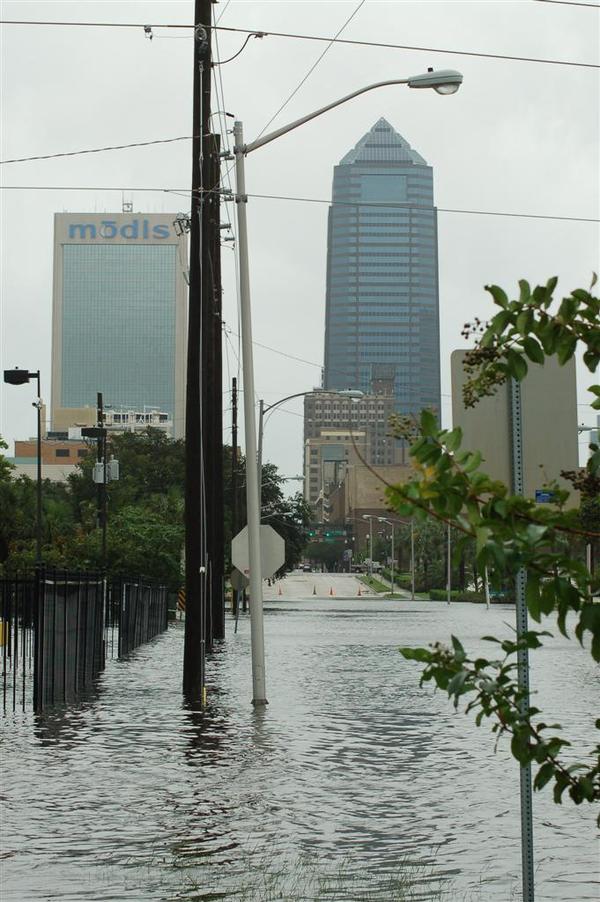
Here's downtown Jacksonville, so you can see that someone had some serious water. I heard that the local cops were doing patrols with an airboat in some areas near the river:


Here's a view out of the front window of the Wanderlodge during some of the rain:


We were driving over to the Broken Spoke (neighborhood bar) and the cops were blocking Cesery, which is a fairly major road in these parts. Never mind that the traffic lights were out, there was a power line down across Cesery, blocking traffic.